

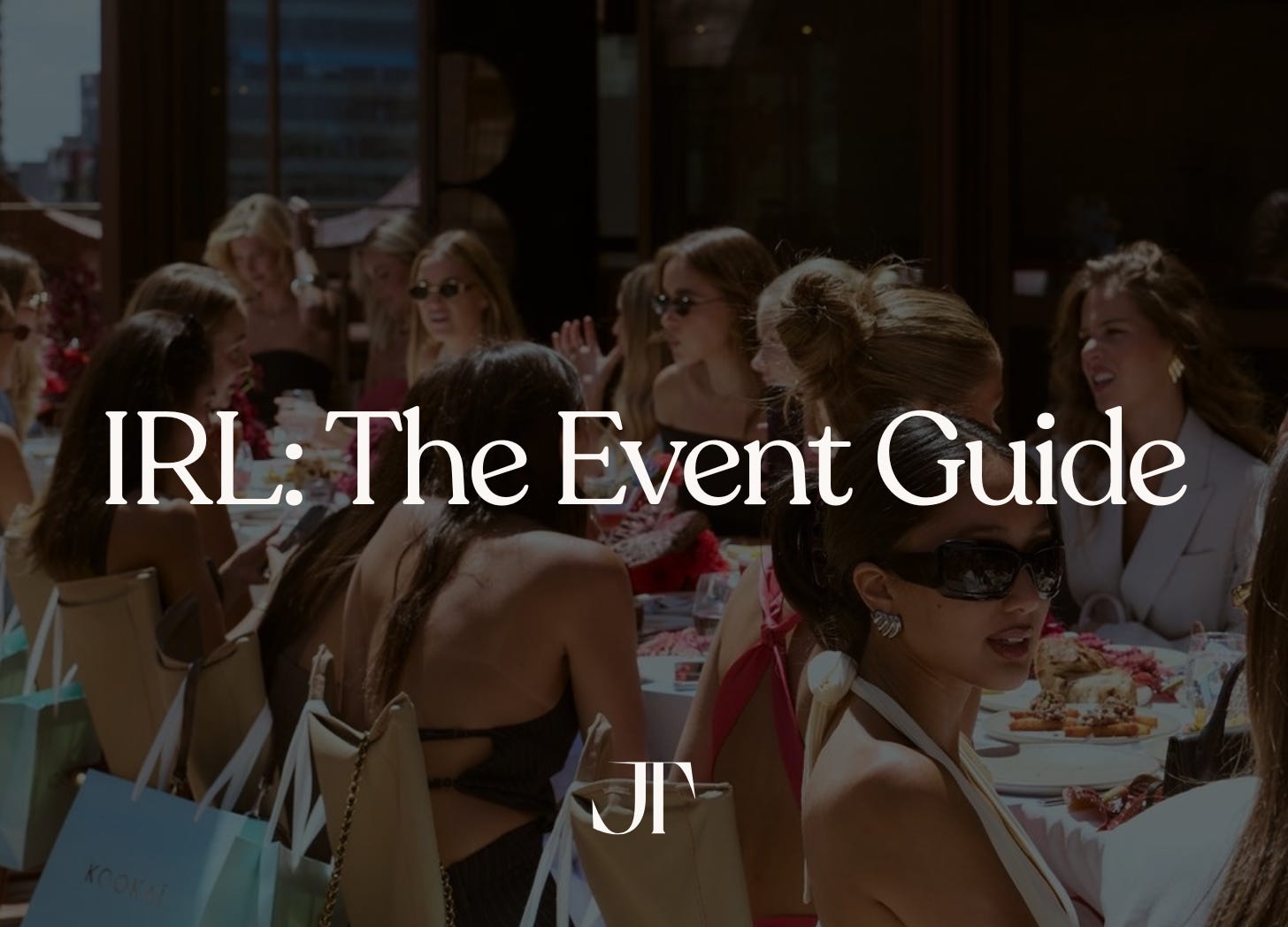
The brands that will still exist in a decade are the ones getting themselves offline and in the room right now. The rest? Becoming less and less relevant as they compete in the sea of sameness we’re seeing online, especially as AI ramps up.
Every brand is posting. Every brand is running ads. Every brand is chasing reach. And almost none of them are building anything their customers would actually defend, recommend, or return to without being retargeted into it. This is wild to me, as someone who’s been deeply embedded in the business of experience for fifteen years, and now coaches the event experts leading it.
The numbers confirm what the smartest operators already feel. Global experiential marketing spend hit $128 billion last year. 84% of consumer marketers and 86% of B2B marketers are increasing their event budgets in 2026. 77% of marketers now say live experiences are the single most effective channel they have. AI has flooded every feed with content that all looks and sounds the same, and digital ad spend is producing diminishing returns for almost every brand I speak to.
Most brands are simply taking too long reassigning their spend to the biggest opportunity on the table right now: events.
Call it what you want.. the analog era, offline, IRL, unplugged, in person.. we, the events industry (a trillion dollar industry, btw) call them: EVENTS.
I have spent over a decade in the events industry. I have planned, produced and consulted on hundreds of conferences, launches and brand experiences across every scale and category. I have watched brands burn six figures on campaigns that vanished in 24 hours. I have also watched a 30-person dinner become the foundation of a multi-million dollar brand. Right now, the brands I am watching most closely are the ones that have figured out something most marketers have not.
The room is the strategy.
This guide is the lens I use when I am sitting opposite a founder or a CMO and helping them work out what they should actually be building this year. There are five activation models that consistently deliver more brand equity, more loyalty and more commercial return than any digital alternative. They work at every budget level, from $500 to $500,000. The principle is identical. The execution scales.
1. The Insider Dinner
The most underrated activation in marketing right now is also the cheapest to run.
A long table. Twelve to sixteen of your best customers, top prospects, or strategically chosen guests. A meal you did not cut corners on. Two or three deliberate moments of conversation that create real connection, real memory, and real commercial momentum.
That is the entire format. And it is quietly responsible for more six-figure deals, more brand loyalty, and more word-of-mouth growth than most founders realise.
The reason it works is structural. Most marketing is one-to-many and asymmetrical. The brand talks, the audience consumes, and the relationship stays transactional because nobody ever actually sat in a room together. A dinner inverts that completely. The brand listens. The audience talks. The relationship deepens because the brand is creating space rather than demanding attention, and people remember how a room felt for years after they have forgotten your last campaign entirely.
I have seen founders close six-figure contracts at dinners that cost them less than a single Instagram ad campaign. I have seen brand affinity built in three hours that no amount of content could replicate. The Insider Dinner is the single highest-leverage activation for early-stage and mid-market brands and almost nobody is using it well.
How to run it properly:
Cap at 16 guests. Above that, the conversation fragments and you lose the intimacy that makes the format work. If you want 30, host two dinners.
Build a guest list with a single shared characteristic. Top 15 customers. 12 founders in the same revenue band. 10 prospects you want to convert plus 6 existing customers who can sell for you in the room without being asked.
Spend more on the venue and food than you think you should. A $3,000 dinner for 12 will outperform a $500 one every time because people remember the quality of the room long after they forget what was said.
Plant two or three seeded conversations. Brief one or two people in advance to bring up specific topics that will trigger the conversation you want the table to have organically.
Do not pitch. The dinner does the pitching for you. If you turn it into a sales presentation you collapse the format entirely and everyone leaves feeling like they were tricked into attending.
Send a hand-written follow-up note within 48 hours. A card, not an email. This is the single highest-converting follow-up move I have seen in over a decade of watching what actually works.
Run it quarterly at minimum. Treat it as the strategy, not something you do once and forget about.
2. The Neighbourhood Pop-Up
This is the activation model that has had the loudest year, and for good reason.
Glossier wheeled its Balm DotWorld pop-up into Mall of America for two days, gave shoppers the chance to customise their lip balm with charms, and turned a product launch into a viral moment that spread across cities without a single paid placement driving it. Kayali parked a custom Airstream on a SoHo street corner steps from a Sephora and turned the pavement into a flagship experience that people queued around the block for. Skims has run pop-up activations in malls across the US that consistently produce queue moments and TikTok content the brand could not have manufactured if it tried.
You do not need to copy the format. The thing worth studying is the principle underneath: physical proximity to your customer at the right moment, in the right neighbourhood, with the right tone, is now one of the most powerful brand-building moves available to any founder willing to think beyond the feed.
Pop-ups work because they convert curiosity into commerce in a single encounter. A Harris Poll found 76% of Americans now connect more deeply with brands through in-person experiences. Nearly three-quarters of Gen Z shop in-store at least once a week, and they are using physical space as discovery in a way that should make every digital-first founder pay very close attention. The brands that show up in the right physical neighbourhoods are showing up exactly where their customers are already choosing to look.
How to run it properly:
Choose location based on who walks past, not what is cheap to rent. A $5,000 weekend in the right neighbourhood beats a $1,500 weekend nobody walks through every single time.
Build one share-worthy moment into the pop-up. A photo wall, a custom product, a free gift with a queue worth standing in. People do not share rooms. They share moments, and you need to design that moment deliberately.
Design every detail with TikTok and Instagram transfer in mind from the beginning. The pop-up is a content engine first and a sales channel second, and if you get the content right the sales follow for months afterwards.
Run it for two to four days, not two to four weeks. Scarcity drives urgency. Long pop-ups feel like permanent stores nobody bothered to properly open and the energy dies within a week.
Time it to a launch, an anniversary, or a cultural moment. Glossier ties pop-ups to product drops. Vita Coco tied theirs to Valentine’s Day. Random timing produces random results and wasted budget.
Have inventory and digital infrastructure ready for the spike afterwards. If your pop-up works, branded search and site traffic will jump within 24 hours and your listing pages need to be ready before the pop-up even opens.
If you are reading this and already thinking about which model fits your brand, you are exactly the kind of person I write for every week. I publish insider strategy on the business of events, brand-building, and what the smartest founders are doing offline right now.
3. The Cultural Takeover
This is where the budget and the ambition step up, but the principle underneath is exactly the same. You take a location, a moment, or a piece of cultural infrastructure that already carries meaning, and you make your brand inseparable from it.
K18 turned Grand Central Terminal into a live Guinness World Record attempt for the most hair flips filmed in 24 hours, designed for cameras from the moment it opened and built to travel across every platform for weeks afterwards. Liquid Death has turned music festivals, college campuses and skate parks into year-round brand stages that feel so native to the environment that the audience forgets it is marketing at all. 818 Tequila has built an entire annual ecosystem around Coachella with the 818 Outpost, an invite-only experience that doubles as the brand’s biggest annual content moment and creates a waiting list that grows every single year.
The Cultural Takeover works because it borrows credibility from something your audience already cares about. You are not asking them to come to you. You are showing up where they already are, inside something they already love, and making your brand part of the memory they were going to have anyway.
How to run it properly:
Pick one cultural moment per year and own it properly rather than spreading thin across many. Owning Coachella is more valuable than showing up at six festivals badly, and the compounding effect of returning to the same moment year after year is enormous.
Tie the activation to a story already happening at the event, not a pitch you bolt on top of it. If the festival is about discovery, your activation is about discovery. If the event is about community, your brand shows up as community.
Invest in the design. Cultural takeovers live or die on aesthetic, and mediocre design at a high-status event makes you look smaller than if you had not shown up at all.
Plan for content amplification before the activation goes live. The activation itself is the seed. The content distribution is the harvest, and most brands spend 90% of their budget on the seed and almost nothing on making sure anyone beyond the room ever sees it.
If the budget is below $50,000, do not attempt this format. Pick a different model from this list. Underfunded cultural takeovers backfire publicly and damage brand perception rather than building it.
4. The Education Experience
Neutrogena hosted Adulthood USA in LA earlier this year to launch its adult acne range. They transformed a blank-canvas venue into a fully built neighbourhood with a laundromat, a car wash, and a convenience store, and each space taught the product in the context of real adult life rather than in the context of a product demo that nobody would have chosen to attend. Sephora has run hosted skincare classes in major store locations that consistently drive higher-margin product sales than any of its in-app tools. Lululemon has built an entire global brand on free yoga classes hosted in-store that cost almost nothing to run and create lifetime customers.
This is the most underused model on this list, and it is also the most strategically interesting for any brand with a complex or technical proposition that struggles to explain itself in a caption. Education experiences turn product knowledge into spatial story. They convert what would otherwise be a brochure or a digital tutorial into something the customer walks through, touches, and remembers in their body for months afterwards.
How to run it properly:
Design the experience around the question your customer is actually asking, not the product feature you want to talk about. Customers ask “how do I solve this?” and if you answer that question in a room they can stand inside, you win their trust faster than any funnel ever could.
Make it doing, not watching. Hands on the product. Skin on the skincare. Feet on the mat. Watching a brand explain itself is content. Doing something with a brand is memory, and memory converts.
Bring in a credible expert. A dermatologist, a chef, a coach, an athlete teaching alongside the brand turns marketing into education, and education converts trust faster than marketing does every single time.
Cap attendance and make it exclusive. Free does not mean low value. Make people apply or RSVP to attend. Friction increases perceived value and the people who make the effort to show up are the people most likely to buy.
Capture content during the experience and use it for 90 days afterwards. One Education Experience can fuel a quarter of social content if you film it properly, and most brands forget to do this and lose 80% of the value they just created.
I break down moves like this every week on The Debrief. Cultural commentary, event strategy, and the insider perspective on what the smartest brands are building right now. If you want to think about events the way the best operators do, this is where that thinking lives.
5. The Curated Room
The fifth model is the most powerful and the most strategic on this list. It is also the one I know best, because it is the model I have built my own business around and the one I believe will define the next era of brand-building for any founder paying attention.
A Curated Room is a recurring, invite-only gathering of carefully selected people, hosted by your brand, designed to build long-term community over multiple touchpoints across a year or longer. Hampton does this for founders generating over $1 million per year. Chief does this for senior women in business. Boardroom does this for high-achieving women across finance, media and sport. I do this for top operators and founders inside the events industry through Events Elite.
The Curated Room is different from every other format on this list because it is not a single moment. It is a long-term commitment to a defined group of people who become, over time, the most powerful commercial asset your brand will ever own. Done well, it creates the kind of loyalty that no campaign can manufacture. The members of the room become advocates, repeat buyers, and sources of word-of-mouth introductions that compound for years afterwards in ways that no ad spend can replicate.
This is the model I expect to see explode in the next three years. Brands that commit to recurring, intimate, high-quality community will end up owning a market position that is essentially uncontestable, because relationships compound and content does not.
How to run it properly:
Define the entry standard sharply. Hampton requires $1m revenue. Chief requires senior leadership. The room only works if everyone in it qualifies, and the moment you dilute the entry criteria the room loses its gravitational pull.
Charge for it, even if you do not need the money. Free rooms attract drift. Paid rooms attract commitment. Even a token annual fee transforms the energy of the group and signals that what happens inside is worth protecting.
Design at least four in-person touchpoints per year. The room cannot survive on a Slack channel and one annual dinner. You need recurring physical proximity for the relationships to deepen past surface-level networking into something that actually changes how people operate.
Hire someone whose only job is community. Not a marketer repurposing a community Slack on the side. A dedicated community lead whose entire focus is the quality of the relationships inside the room.
Be ruthless about who you let in. One wrong member dilutes the value for everyone else, and the strongest curated rooms in the world are stronger because of who they say no to than because of who they say yes to.
Plan a flagship annual experience. A retreat, a summit, a destination weekend. Members will renew for the flagship moment alone if you design it with enough intention, and the content from that experience becomes your best marketing for the following twelve months.
What links all five
Every model on this list works on the same principle. People remember how you made them feel. They do not remember what you posted.
The brands that will still be standing in a decade are the ones investing in real rooms right now. The ones that are not will be wondering where their audience went and why their content stopped converting and whether the algorithm changed again or whether something deeper shifted underneath them while they were busy optimising their next carousel.
Pick one model. Commit to it for a year. Run it properly. The compound effect is bigger than anything you will get from your next ad campaign, your next product launch email, or your next attempt to go viral.
If you want to go from reading this to running one
This guide gives you the models. The IRL Events Mini Course gives you the exact strategy to build yours.. drilling your event idea right down to why it exists and who it’s for, picking the right format, working out how to scale it, and making real profit and brand awareness from it. Ten modules, 10 to 30 minutes each, so you can work through it around everything else you’re running.
Get the IRL Events Mini Course →
If you are a founder or operator in events and you want to be in the room where this is the conversation
Everything I just broke down in this guide is the lens I use with the founders and leaders inside Events Elite, my curated mastermind for top operators in the events industry.
We meet virtually multiple times a month: hot seat coaching, roundtables, agency leaders working hours. We have two flagship retreats that consistently changes how the women inside it think about their businesses. We talk about positioning, pricing, brand, wealth, leverage, and what it actually looks like to build something that compounds rather than something that exhausts you.
The calibre of the room is extraordinary. The conversations are the kind you cannot have anywhere else in this industry.
If you are a senior leader or founder in events and you want to be surrounded by peers who are building at the level you are building, I would love to hear from you.
Find out more about Events Elite →

I write The Debrief twice a week for founders who think about events, brand, and business differently.. free every Tuesday, and the deeper analysis for paid subscribers every Friday. If this guide landed for you, you can try the Friday posts free for 7 days.
Juliet x
Great content. Thank you
This is incredibly valuable thank you for sharing